
CSA Basics
FMCSA Updates will Overhaul “CSA Basics” into “Compliance Categories”
The FMCSA is implementing major changes to its Safety Measurement System, transitioning from CSA Basics to Compliance Categories, with simplified severity ratings, consolidated violation codes, and updated thresholds. These changes aim to improve accuracy in identifying high-risk carriers while making the system more straightforward for transportation companies to understand and implement.
Will combine the “Controlled Substances/ Alcohol” category with “Unsafe Driving” which would help focus FMCSA’s investigative resources on carriers with higher crash rates. FMCSA will also divide the existing category “Vehicle Maintenance” into two categories “Vehicle Maintenance: Driver Observed” and “Vehicle Maintenance” to provide more specific information to help motor carriers and enforcement pinpoint unsafe driver behavior and sources of vehicle maintenance issues.
Click the following link for more details regarding the upcoming FMCSA Updates.
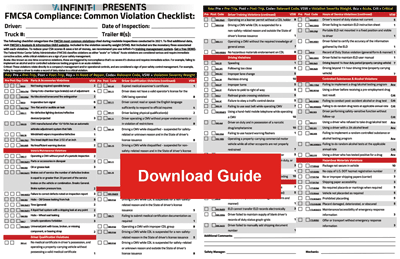
FMCSA Common Compliance Violation Checklist:
What are the CSA Behavior Analysis and Safety Improvement Categories (CSA BASICs)?
The Safety Measurement System (SMS) is organized into seven BASICs, which represent behaviors that can lead to crashes. The BASICs were developed based on information from a number of studies that quantify the associations between violations and crash risk, as well as statistical analysis and input from enforcement subject matter experts.
The BASICs are defined as follows:
- Unsafe Driving BASIC
- HOS Compliance BASIC
- Driver Fitness BASIC
- Controlled Substances and Alcohol BASIC
- Vehicle Maintenance BASIC
- Hazmat Compliance BASIC
- Crash Indicator BASIC
- SMS evaluates a motor carrier’s crash history. Crash history is not specifically a behavior. Rather, it is a consequence of a behavior and may indicate a problem with the motor carrier that warrants intervention. It is based on information from State-reported crash reports and histories or patterns of high crash involvement, including frequency and severity.
BASIC Definitions and Data Sources for Carriers
| BASIC | Operational definition | Data sources |
| Driver Fitness | Operation of commercial motor vehicles by drivers who are unfit to operate them because they lack training, experience, or medical qualification. |
|
| Unsafe Driving | Dangerous or careless operation of commercial motor vehicles. |
|
| Fatigued Driving | Driving commercial motor vehicles while fatigued. |
|
| Controlled Substances/Alcohol Part 392 | Operation of a commercial motor vehicle while impaired by or in possession of alcohol, illegal drugs, or any other substance that renders the driver incapable of safely operating a motor vehicle. |
|
| Crash Indicator | Histories or patterns of high crash involvement, including frequency and severity. Miles carrier logs versus number of accidents |
|
| Vehicle Maintenance | Failure of commercial motor vehicle due to improper or inadequate maintenance. Shifting loads spilled or dropped cargo. |
|
| Hazardous Materials (HM) Compliance — (FMCSR Part 397 and Hazardous Materials Regulations Parts | Unsafe handling of HM on a CMV. Example violations: Release of HM from package, no shipping papers (carrier), and no placards/markings when required. |
|
| Note: Most of the BASICs deal with driver characteristics and behavior. FMCSA will address these driver behaviors by intervening with carriers that use unsafe drivers. FMCSA will also use these same BASICs and underlying data sources to determine the safety fitness of individual drivers. The safety measurement system will score carriers in each BASIC and make a safety fitness determination to indicate (1) whether a carrier should continue to operate. A whitepaper from Jim Dodd, CFO of Southern Refrigerated Transport confirms using VAG’s Infinit-i platform reduces expenses and increases ROI. More details about our CSA Basics Library | ||
FAQs
What are CSA Basics and why are they changing?
CSA Basics are FMCSA’s safety measurement categories. They’re being overhauled into “Compliance Categories” to improve accuracy in identifying high-risk carriers and make the system easier to understand for transportation companies.
How will the Controlled Substances/Alcohol category change under the new system?
It will be combined with “Unsafe Driving” to help FMCSA focus investigative resources on carriers with higher crash rates.
What’s happening to the Vehicle Maintenance BASIC?
It’s being divided into two categories: “Vehicle Maintenance: Driver Observed” and “Vehicle Maintenance” to provide more specific information for motor carriers and enforcement.
What data sources are used to evaluate Driver Fitness BASIC?
Driver Fitness is evaluated through roadside inspection violations, crash reports citing lack of experience or medical issues, and compliance review violations related to driver qualification files.
How is the Unsafe Driving BASIC measured?
It’s measured through driver traffic violations and convictions for behaviors like speeding, reckless driving, improper lane changes, and inattention.
What violations fall under the Controlled Substances and Alcohol BASIC?
This category includes violations related to use or possession of controlled substances or alcohol, covered under FMCSR Parts 382 and 392.
What are the main components of the Vehicle Maintenance BASIC?
It covers mechanical defects, including brakes and lights, and failure to make required repairs, governed by FMCSR Parts 393 and 396.
How is the Crash Indicator BASIC different from other BASICs?
Unlike other BASICs, the Crash Indicator isn’t a specific behavior but rather evaluates consequences through crash history, frequency, and severity.
What records are used to evaluate Fatigued Driving?
Fatigued Driving is evaluated through hours-of-service violations and crash reports where driver fatigue is cited as a contributing factor.
What’s included in Hazmat Compliance BASIC?
It covers proper load securement, cargo retention, and hazardous material handling, regulated by Parts 392, 393, 397, and DOT HM regulations.
How do CSA Basics affect individual drivers?
While CSA Basics primarily address carrier behavior, FMCSA uses the same BASICs and data to determine individual drivers’ safety fitness.
What role do State-reported crash reports play in CSA Basics?
They’re crucial for the Crash Indicator BASIC and provide supporting evidence for various other BASICs when crashes involve specific contributing factors.
How are maintenance violations documented in CSA Basics?
Through roadside inspections, crash reports citing mechanical failures, and compliance review violations related to pre-trip inspections and maintenance records.
What determines a carrier’s safety fitness under CSA Basics?
Carriers are scored in each BASIC category to determine whether they should continue operating based on their safety performance.
How do CSA Basics handle hazardous materials violations?
Through specific HM Compliance measurements, including proper package handling, shipping paper requirements, and placarding/marking regulations.
What documentation is required to maintain good CSA Basic scores?
Carriers need to maintain proper driver qualification files, vehicle maintenance records, hours-of-service logs, and accident reports to maintain good standings in all BASIC categories.
Industry News


