• Login Help
  • Request Pricing
Call Us: 972-232-7305
INFINITI Fleet Safety Training Management System
  • Link to Facebook
  • Link to Twitter
  • Link to LinkedIn
  • Link to Youtube
  • Link to Instagram
  • Link to TikTok
  • Services
    • Online Safety Training
      • Silver
      • Gold
      • Platinum
    • Digital Checklist
    • Custom Video Production
    • FAQ
  • Training Library
    • Truck Driver Safety
    • School Transportation
    • Enterprise Training
    • Premium Content
      • Fuel Efficiency Training
      • Truck Accident Defense Training
      • Sexual Harassment Training Videos
      • Dispatcher Training Program
      • ELDT Training
        • ELDT for Trucking
        • ELDT for School Bus Drivers
        • Purchase ELDT Training
        • Purchase CDL Training
  • Industries Served
    • School Transportation Training
    • Truck Driver Training
    • Enterprise Solutions
  • About Us
    • Our Story
    • Client Success Team
    • Reviews
    • Meet The Team
    • Careers
  • Benefits
    • Return on Fleet Safety Training
    • Prevent Accidents
      • Reduce Accident Costs by 50.7% Yearly
    • Reduce Insurance Costs
    • Regulations & Compliance
      • Improve CSA Scores by 17-50%
    • Operations and Productivity
      • Fuel Efficiency Training
      • Reduce Driver Turnover
      • Overages, Shortages and Damages
      • Reduce Training Costs by Up to 50% Without Cutting Training
  • Events
    • Boot Camp
    • Webinars
  • Free Resources
    • Free Downloads
    • ROI Assessment
    • Industry News/Blog
      • News
      • Client Spotlight
      • Video Releases
      • Webinar Replays
  • Regulations
    • CSA Violation Severity Charts
      • CSA Unsafe Driving Violation Severity Chart
      • CSA Hazmat Violation Severity Chart
      • CSA Fatigued Driving HOS Violation Severity Chart
      • CSA Driver Fitness Violation Severity Chart
      • CSA Alcohol Violation Severity Chart
      • CSA Vehicle Maintenance Severity Chart
    • Proposed FMCSA Updates
    • USDOT English Language Requirement for Truckers​
    • FMCSA Medical Certification Rule Changes & Tools
  • School Bus Driver Training
    • Download School Bus Driver Training Catalog
  • Menu Menu

CSA Violation Severity Charts

6 Biggest Benefits of an LMS for Transportation Companies

  • Increased driver comprehension of training material
  • Decreased frequency and severity of accidents and incidents
  • Improved CSA scores
  • Digital, automatic record-keeping provides indisputable proof of training in legal matters and DOT audits
  • Streamlined communication and shortened driver orientation
  • Improved ability to provide corrective action training

FMCSA Common Compliance Violation Checklist:
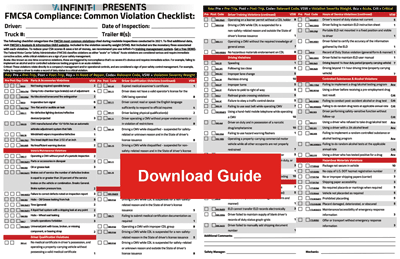
DOT Out of Service Violations List

Controlled Substance AlcoholDriver FitnessFatigued Driver/HOSHazmatUnsafe DrivingVehicle Maintenance/Cargo Securement

FMCSA CSA Violation Severity by Numeric Weight Charts

The tables in this appendix contain all violations used in the Safety Measurement System (SMS), along with the corresponding Federal Motor Carrier Safety Regulations (FMCSRs) or Hazardous Materials Regulations (HMRs) section. Each Behavior Analysis and Safety Improvement Category (BASIC) is represented by two tables. The first table lists the BASIC violations and the second table lists Acute and Critical Violations related to this BASIC.

Each BASIC violation is assigned a severity weight that reflects its relevance to crash risk. Crash risk is defined as the risk of crashes occurring and the consequences of the crash after it occurs. Within each BASIC, the violations are grouped based on their attributes so that similar violations can be assigned the same severity weights. Severity weights, discussed in more detail below, only reflect relative crash risk within a BASIC and are not comparable across the BASICs.

Interpretation of the Severity Weights The violation severity weights in the tables that follow have been converted into a scale from 1 to 10, where 1 represents the lowest crash risk and 10 represents the highest crash risk relative to the other violations in the BASIC. Because the weights reflect the relative importance of each violation only within each particular BASIC, they cannot be compared meaningfully across the various BASICs. Therefore, a 5 in one BASIC is not equivalent to a 5 in another BASIC, but the 5 does represent the approximate midpoint between a crash risk of 1 and 10 within the same BASIC. The “Violation Group” column in each table identifies the group to which each violation has been assigned. Each violation within a violation group is assigned the same severity weight.

Violations in the tables that follow are used by SMS at the specified severity weight unless the citation result associated with the violation is adjudicated and documented as “dismissed/ not guilty.” Additionally, when the citation result for a violation is documented as “convicted of a different charge,” then the severity weight is set to 1 and it is not subject to an additional out-of-service (OOS) severity weight of 2.

In order for an adjudicated citation result to be documented for a violation (and subsequently impact SMS), drivers or carriers must submit certified documentation of the judicial proceeding results through a Request for Data Review (RDR) in the Federal Motor Carrier Safety Administration’s (FMCSA) DataQs system to initiate this process. This process only applies to inspections conducted on or after August 23, 2014.

Derivation of the Severity Weights

The Violation Group Column in each table identifies the group to which each violation has been assigned. In order to determine the severity weights crash involvement and crash consequence, the following five-step process was invoked:

  1. BASIC Mapping – All roadside safety-related violations were mapped to an appropriate BASIC so the severity weight analysis could be conduced on each individual BASIC.
  2. Violation Grouping – All violations in each BASIC were placed into groups of similar violations based on the judgment of enforcement subject matter experts. These groups, listed in the “Violation Group” column in each table, make it possible to incorporate otherwise rarely discovered violations into the robust statistical analysis used to derive the severity weights. The violation grouping also ensured that similar types of violations received the same severity weight.
  3. Crash Occurrence Analysis – Statistical analysis was performed to quantify the extent of the relationship between crash involvement on the one hand and violation rates in each violation group, within each BASIC, on the other hand. A driver approach was used in this analysis. This approach was taken due to strong demonstrable relationships between driver crashes and violations documented in prior research by the Volpe National Transportation Systems Center. The earlier research was conducted in support of FMCSA’s Compliance Review Work Group (CRWG), the CSA program’s predecessor.

Based on the conclusions from the earlier research, the Volpe Center developed a Driver Information Resource (DIR) for FMCSA. The DIR uses individual crash and inspection reports from all States to construct multi-year driver safety histories for individual commercial drivers. Multivariate negative binomial regression models were used to quantify the strength of relationships between driver violation rates in individual violation groups and crash involvement.

  1. Crash Consequences Analysis – While the statistical modeling described in Step 3 provides an empirical basis for associating violations and crash occurrence, it does not address the violations relationship to crash consequence. To factor in the risk associated with crash consequence enforcement subject matter experts representing State and Federal field staff provided input for modifying preliminary severity weight defined in step 3. This approach helped balance the violation risk associated with crash involvement (occurrence) and crash consequence.
  2. CSMS Effectiveness Test – Various severity weighting schemes developed in steps 1 through 4 were applied to the Safety Measurement System (SMS) to provide an empirical evaluation of the weighting schemes. This empirical evaluation, or “SMS Effectiveness Test,” was modeled after the SafeStat Effectiveness Test.21 The SMS Effectiveness Test was accomplished through the following steps: (1) performing a simulated SMS run that calculates carrier percentile ranks for each BASIC using historical data; (2) examining each carrier’s crash involvement over the immediate 18 months after the simulated SMS timeframe; and (3) observing the relationship between the percentile ranks in each BASIC and the subsequent post-SMS carrier crash rates. The SMS Effectiveness Test provides an environment to evaluate various severity weighting schemes in terms of their impact in identifying high-risk carriers. It also provides a means of testing other weight schemes, such as the out-of-service (OOS) weight, to help optimize SMS’s effectiveness.

INFINITI Fleet Safety Training™ is a cost-effective, easy-to-use web-based solution for trucking companies to deliver information to internal and external audiences, with the ability to track and report user participation and comprehension. Infinit-i™ has unlimited potential for training employees, sharing information across multiple locations and improving productivity!

A whitepaper from Jim Dodd, CFO of Southern Refrigerated Transport confirms that INFINITI Fleet Safety Training reduces expenses and increases ROI.

Industry News

INFINITI November 2026 Catalog & Video Release
October 5InVideo Releases Tags:driver safety training, Fleet Driver Safety Training, fleet safety training, loading dock safety training, online fleet safety training, Safety Training Videos, school bus safety, school bus safety training videos, trucking safety, Trucking safety training videos

INFINITI November 2026 Catalog & Video Release

Sample Employee Handbook Policy
October 2InNews Tags:Binding contract, company handbook employee handbook policy for employers, compliance, Disclaimer language, Employee education, Employee handbook, employee handbook policy template, Employee handbook policy updates, employee policies, Fair Labor Standards Act (FLSA), Federal and state laws, how to create an employee handbook, HR policies, litigation, sample company employee handbook, Well-meaning policies, what to include in an employee handbook, workplace policies

Employee Handbook Policy Guide For Employers

FMCSA Medical Certification Reporting Changes
October 1InTrucking News Tags:can you get DOT medical card with diabetes, CDL physical, cost of DOT physical exam, DOT exam, DOT medical card grace period, DOT medical card renewal process, DOT physical, DOT physical blood pressure requirements, DOT physical drug test requirements, DOT physical requirements 2026, DOT requirements, FMCSA Medical Card Rule Changes in 2026, FMCSA medical certification rules 2026, FMCSA rules, how long is a DOT physical good for, medical card, Medical certificate, medical examiner, physical exam, school bus driver certification cost and requirements, where to get DOT physical near me

FMCSA / DOT Medical Card Rule Changes: 2025 Rule & 2026 Updates

2026 Tennessee Trucking Association Fleet Safety Awards
September 30InAwards Tags:2026 Fleet Safety Award winners, driver safety, fleet safety, fleet training, INFINITI Fleet Safety award-winning clients, safety awards, Tennessee Trucking Association Fleet Safety Awards, Tennessee trucking fleet safety champions, Transportation Safety Awards, trucking companies recognized for fleet safety, trucking safety

2026 Tennessee Trucking Association Fleet Safety Awards

Judicial Hellhole Map
September 25InNews, Trucking News Tags:best practices for truck driver compliance, Commercial vehicle accident prevention, commercial vehicle litigation, Compliance Training, digital safety training for trucking companies, how to prevent nuclear verdicts in trucking, how to reduce trucking liability costs, judicial hellholes, nuclear verdicts, preventing truck accidents through training, safety training, truck accidents, truck driver safety training programs, truck driver training, trucking safety, what states are judicial hellholes

Judicial Hellhole Map for Trucking

Webinar Replay 125: The Safety Meeting is About to Change Introducing Live Training
September 24InWebinar Replays Tags:defensive driving, driver safety training program, driver training, fleet safety, fleet safety meeting training, live fleet safety training, online safety training for drivers, Safety Meeting, safety training, trucking safety meeting training

Webinar Replay 125: The Safety Meeting is About to Change

Enterprise Client Success Team
September 21InBusiness Training News Tags:best practice consultation, business analysis, Client Success Team, digital learning, employee development success, mission client success, quarterly review, right tools, system set-up, technical support

Enterprise Client Success Team

September 18InTrucking News Tags:driver appreciation, national truck driver, Role of Truckers in Daily Life, Thank a Trucker, Thank you truck drivers, truck driver, Truck Driver Appreciation, trucker, Trucker Sacrifices, Trucking Industry Challenges

Truck Driver Appreciation Week 2025! Thank You Truckers!

FMCSA-Clearinghouse Requirements for Employers
September 16InTrucking News Tags:annual Clearinghouse query, CDL drug and alcohol testing, Clearinghouse consent, Clearinghouse employer requirements, Clearinghouse full query, Clearinghouse limited query, Clearinghouse violation reporting, drivers, drug, drug and alcohol, drugs, enhanced safety culture, federal regulations, FMCSA, FMCSA Drug and Alcohol Clearinghouse, INFINITI Fleet Safety Training, legal trucking liability, return-to-duty process, risk mitigation, safety, SAP follow-up testing, trucking, trucking industry

FMCSA Clearinghouse Requirements for Employers Guide

Your Drivers Are Trained. But Are You Protected?
September 16InWebinar Replays Tags:commercial driver safety training, defensive driving course, driver safety, driver safety training program, driver training, Drivers Are Trained, Fleet Driver Safety Training, fleet safety, truck driver safety trainingdefensive driving

Replay 124: Your Drivers Are Trained but Are You Protected?

  • #1 Truck Driver Safety Training LMS
  • Transportation Insurance Advantages
  • Proposed FMCSA Updates
  • Safety Manager Tools for Training Drivers
  • Transportation Onboarding
  • Powerful Corrective Action Training for 2026
  • Driver Accident Prevention
  • CSA Overview
  • 7 CSA Basics for Transportation Companies
  • FMCSA CSA Frequently Asked Questions CSA FAQ’s
  • CSA Hazmat Violation Severity Chart
  • Dynamic Driver Checklists
  • Driver Safety Video Content
  • Overages, Shortages and Damages
  • FMCSA Carrier Safety Measurement System
  • CSA Driver Fitness Violation Severity Chart
  • CSA Fatigued Driving HOS Violation Severity Chart
  • CSA Alcohol Violation Severity Chart
  • CSA Audit Information
  • CSA Safety Management Cycle
  • CSA Violation Severity Charts
  • CSA Unsafe Driving Violation Severity Chart
  • CSA Pre-Employment Screening
  • CSA Vehicle Maintenance Severity Chart
  • Transportation Content & Premium Features

Need Help?

  • Login Help
  • Request A Demo
  • Client Success Team
  • Contact Us

Call Now

Sales: 972-232-7305

Support: 903-792-3866 x300

About

  • Premium Training Content
  • Services
  • Reviews & Testimonials
  • Meet The Team
  • Careers
  • About

Free Resources

  • Training Videos
  • Truck Driver Recruiting
  • CSA Guide
  • Free Downloads

Benefits

  • Reduce Motor Carrier Insurance Costs
  • Accident Prevention Training and Legal Defense
  • Regulations & Compliance
  • Operations and Productivity
  • Reduce Accident Costs by 50.7% Yearly
  • Improve CSA Scores by 17-50%
  • Reduce Driver Turnover
  • Fuel Efficiency Training
  • Reduce Training Costs by Up to 50% Without Cutting Training
  • Overages, Shortages and Damages
  • Training Management System Benefits
  • #1 Truck Driver Safety Training LMS

Subscribe

Get our iPhone app Get our Android app

® 2026 INFINITI Workforce | WordPress Design by Press Wizards
  • Link to Facebook
  • Link to Twitter
  • Link to LinkedIn
  • Link to Youtube
  • Link to Instagram
  • Link to TikTok
  • Privacy Policy
  • Terms & Conditions
  • Cookie Policy
Scroll to topScroll to top Scroll to top