
WHAT TRIGGERS A DOT COMPLIANCE AUDIT?

What Triggers a DOT Compliance Audit?
When it comes to a DOT compliance audit, it’s not a matter of “if”, it’s a matter of “when”. An audit is triggered after an accident or poor review during a roadside stop. These audits can also be triggered by bad CSA scores for a company.
On top of these issues that can trigger an audit, the DOT does do random audits at times, so you will find yourself going through a compliance audit if you work in the trucking industry. When the auditor comes, you need to be ready with proper documentation.
Remember, if it’s not documented, dated, and readily available, it didn’t happen.
How does the DOT oversee trucking firms?
The Department of Transportation (DOT) is a federal regulatory agency that oversees all transportation in the United States. The Federal Motor Carrier Safety Administration (FMCSA) is a division of the DOT tasked with regulating the commercial vehicle industry.
The FMCSA develops and enforces regulations meant to keep the roadways and truck drivers safe. All trucking companies and drivers must follow all FMCSA regulations or face penalties such as fees or having their trucks taken off the road.

The Department of Transportation (DOT) conducts audits to ensure trucking companies comply with safety regulations. Here’s what can trigger an audit:
- High CSA Scores: The FMCSA’s CSA program assigns safety ratings. High scores in areas like crashes, driver violations, or vehicle maintenance raise red flags.
- Serious Accidents: Accidents, especially those with fatalities, will get the DOT’s attention.
- Roadside Violations: Drivers placed out-of-service during inspections increase the company’s audit risk.
- Safety Complaints: Even complaints from disgruntled employees are taken seriously by the FMCSA.
- Random Audits: The DOT also conducts random audits to ensure overall compliance.
Here are some tips to avoid a DOT audit:
- Regularly assess your safety programs and identify areas for improvement.
- Conduct mock audits to identify weaknesses in your compliance procedures.
- Ensure you have proper documentation readily available for the auditors.
- Use a DOT Compliance Checklist to help make sure all audit items are checked regular.

WHAT DO YOU NEED DURING A DOT AUDIT?

When an auditor comes, it’s important to have all the necessary documentation ready, including driver logs, medical records, and safety training records. This documentation could mean the difference between a simple audit and getting your trucks parked.
One of the most important things an auditor looks for is your company’s safety record. They want to see how you’re implementing driver safety training programs, and more importantly how well they are working.
They will also look at your company policies. They want to make sure all company personnel have read and are following these policies. It’s important to make sure all your training documentation can prove consistent efforts towards maintaining a culture of safety.
 The Consequences of a Bad Audit

If your DOT compliance review audit doesn’t show sufficient training and safety documentation, you could end up with a Conditional status, meaning the auditor provides an action plan and a deadline for you to implement it.
Conditional status can put a target on your company. Your trucks will get stopped more often and will be subjected to more frequent roadside inspections. You’ll also find it difficult to find clients and drivers willing to work with your company if you have a conditional status.
Without the right tools in place, you could end up costing your company time and money.
Protecting Your Company During an Audit

The best way to make sure you have all your documentation ready for an audit is to implement an online DOT safety training program like Infinti-I Workforce Solutions. The INFINITI system is easy for drivers to use and makes maintaining and accessing records easy for you.
The cloud-based solution allows drivers to complete ongoing short, interactive courses, and maintains all records of participation and testing scores with date and timestamps. This means when DOT comes calling for an audit, you have all the documentation you need to keep your trucks on the road and in good standing.
Infint-I can help you solve your biggest safety training issues, all while saving your company money. For more information about how, download our Trucking Insurance Whitepaper.
Prepare Against Your Next DOT Compliance Audit
A DOT compliance audit is almost inevitable for trucking companies, triggered by accidents, poor roadside reviews, bad CSA scores, or even random selection by the DOT. During an audit, having proper documentation readily available is crucial. If it’s not documented and easily accessible, it’s as if it didn’t happen. Effective DOT audit preparation involves maintaining meticulous records, implementing robust compliance systems, and regularly reviewing your documentation to ensure you’re ready when auditors arrive. Here’s how you can navigate DOT audits effectively:
- High CSA Scores: Red flags are raised by high scores in crashes, driver violations, or vehicle maintenance.
- Serious Accidents: Fatal accidents especially draw the DOT’s attention.
- Roadside Violations: Out-of-service incidents during inspections increase audit risks.
- Safety Complaints: Even employee complaints are taken seriously by the FMCSA.
- Random Audits: The DOT conducts random audits to ensure overall compliance.
To avoid audits or mitigate their impact:
- Regularly assess safety programs for improvement.
- Conduct mock audits to identify compliance weaknesses.
- Ensure all required documentation is readily available for auditors.
INFINITI is Here for Your Company
Your company could be subject to a DOT compliance audit at any time, but especially after incidents on the road. A culture of safety goes a long way towards passing these audits, and that’s where INFINITI Fleet Safety Training is on your side.
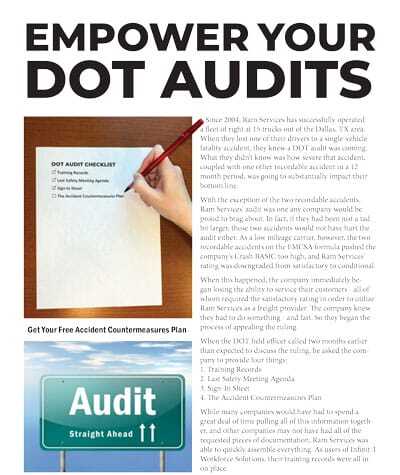
A trucking company Ram Services and one of our clients with a good safety record except for 2 accidents faced a DOT audit downgrade due to the accidents. However, because they had well documented training records and accident countermeasure plans, they were able to appeal the downgrade and get their rating back to satisfactory quickly. Read more on how Ram Services empowered their DOT Audits.
Before you take your chances with your next audit, check out how INFINITI can help you create a program to meet your safety and compliance needs. To see it for yourself, request a demo today.
Learn why Over 1,500 Companies Trust INFINITI for DOT Safety Training
FAQs
What triggers a DOT compliance audit?
A DOT compliance audit can be triggered by serious crashes, high CSA scores, repeated roadside violations, driver complaints, safety complaints, or random selection by the DOT. For trucking companies, the most common warning signs are patterns of unsafe driving, vehicle maintenance problems, hours of service violations, drug and alcohol program issues, or incomplete driver qualification files. A DOT compliance audit is designed to determine whether your company has safety management controls in place. The best way to prepare is to keep driver files, training records, maintenance records, inspection reports, and corrective actions organized before an auditor requests them.
What is the role of the DOT and FMCSA?
The Department of Transportation, or DOT, oversees transportation safety across the United States. The Federal Motor Carrier Safety Administration, or FMCSA, is the agency within the DOT that regulates commercial motor carriers, drivers, and trucking safety programs. During a DOT compliance audit, FMCSA or state enforcement officials may review your company’s records to determine whether you are following applicable safety regulations. This can include driver qualification files, hours of service records, maintenance documentation, accident records, drug and alcohol testing records, and safety training documentation. The goal is to make sure your company is operating safely and managing risk properly.
What documentation is needed during a DOT audit?
During a DOT compliance audit, trucking companies may need to provide driver qualification files, CDL and medical card records, motor vehicle records, hours of service logs, ELD records, vehicle maintenance files, annual inspection reports, drug and alcohol testing records, Clearinghouse query documentation, accident registers, roadside inspection reports, and safety training records. Auditors may also look for written policies, corrective action records, and proof that the company reviews violations and addresses safety problems. The easier these records are to find and verify, the easier the audit process becomes. Organized documentation can help show that your company takes compliance seriously.
What are the consequences of a bad audit?
A bad DOT compliance audit can lead to serious consequences for a trucking company. Depending on the findings, the company may receive a Conditional or Unsatisfactory safety rating, be required to submit a corrective action plan, face increased roadside inspections, or deal with fines and enforcement actions. A poor audit result can also hurt customer confidence, insurance relationships, driver recruiting, and overall company reputation. If the audit shows missing training records, incomplete driver files, weak maintenance documentation, or repeated safety violations, the company may have to prove that problems have been corrected before its rating or standing improves.
How can I prepare for a DOT compliance audit?
You can prepare for a DOT compliance audit by reviewing your records before the auditor does. Start with driver qualification files, CDL and medical card expirations, motor vehicle records, drug and alcohol testing records, Clearinghouse queries, hours of service logs, maintenance files, annual inspections, accident registers, and safety training documentation. Then look for missing, expired, incomplete, or inconsistent records. Conducting regular internal reviews or mock audits can help identify weak spots before they become audit findings. It is also important to document corrective actions, retraining, repairs, and follow-up steps so you can show an active safety management process.
What is the role of CSA scores in a DOT audit?
CSA scores can play an important role in a DOT compliance audit because they help the FMCSA identify safety trends within a trucking company. High scores or repeated violations in areas such as unsafe driving, hours of service, vehicle maintenance, controlled substances, crash indicators, or driver fitness can raise red flags. If your company has poor CSA performance, auditors may look more closely at the records connected to those problem areas. Improving CSA scores usually requires more than checking boxes. It takes consistent driver training, maintenance follow-up, violation tracking, and documented corrective action when problems appear.
How does the DOT respond to serious accidents?
Serious accidents can draw DOT and FMCSA attention, especially when they involve fatalities, injuries, hazardous materials, or patterns of preventable crashes. After a serious crash, investigators may review the company’s driver qualification files, hours of service records, drug and alcohol testing records, vehicle maintenance history, accident register, and safety training documentation. A DOT compliance audit may be used to determine whether the company had proper safety controls in place before the crash. This is why it is important to document driver training, vehicle inspections, corrective actions, and post-accident procedures before a serious incident happens.
What impact do roadside violations have on a DOT audit?
Roadside violations can increase the chance of a DOT compliance audit, especially when violations happen repeatedly or result in drivers or vehicles being placed out of service. Common problems include brake violations, tire issues, lighting defects, hours of service violations, missing documents, and driver qualification issues. During a DOT compliance audit, inspectors may review whether the company corrected the violations, repaired the vehicle, retrained the driver, and documented the follow-up. A single violation may not tell the whole story, but repeated violations can suggest weak safety management. That is why every roadside inspection should be reviewed and addressed.
How seriously does the FMCSA take safety complaints?
The FMCSA takes safety complaints seriously, even when they come from employees, former employees, drivers, customers, or the public. Complaints can involve unsafe equipment, pressured driving, hours of service violations, drug and alcohol concerns, poor maintenance practices, or lack of required training. A complaint may lead to a closer review or even a DOT compliance audit if the issue appears serious enough. Companies should have a process for documenting complaints, investigating concerns, correcting problems, and keeping records of what was done. Strong documentation helps show that your company responds to safety issues instead of ignoring them.
What role do random audits play in DOT compliance?
Random audits are part of DOT compliance because not every audit is triggered by a crash, complaint, or high CSA score. A company can be selected for a DOT compliance audit even when it believes there are no major red flags. That means trucking companies should stay audit-ready throughout the year, not just after a warning sign appears. Driver files, maintenance records, drug and alcohol program records, logs, accident registers, and training documentation should be kept current at all times. Random audits are a reminder that compliance is an ongoing process, not something to prepare for at the last minute.
What happens if you fail a dot audit?
If you fail a DOT compliance audit, your company may receive a Conditional or Unsatisfactory safety rating, depending on the seriousness of the findings. You may be required to submit a corrective action plan, fix documentation problems, retrain drivers, improve maintenance controls, or address drug and alcohol program weaknesses. A failed audit can also lead to fines, increased inspections, insurance concerns, lost business opportunities, and damage to your company’s reputation. The most important step after a failed audit is to document every corrective action clearly. Auditors want to see that the company identified the problem and fixed it.
What is a dot audit?
A DOT audit is a review of a trucking company’s safety and compliance records to determine whether the company is following applicable DOT and FMCSA regulations. A DOT compliance audit may include driver qualification files, hours of service records, drug and alcohol testing records, maintenance files, inspection reports, accident registers, insurance records, and safety training documentation. The audit may be triggered by CSA scores, crashes, roadside violations, complaints, or random selection. The purpose is to determine whether the company has safety management controls in place. Companies that keep organized records are usually better prepared for the audit process.
Which trucking safety/compliance software makes passing DOT audits easiest?
The trucking safety and compliance software that makes passing a DOT compliance audit easiest is the one that helps your company organize training records, driver documentation, corrective actions, maintenance follow-up, and safety communication in one consistent process. INFINITI Fleet Safety Training helps fleets assign safety training, document completion, track participation, upload custom policies, and prepare stronger records before an auditor asks for them. Instead of waiting until a DOT compliance audit is scheduled, fleets can use the system throughout the year to support ongoing safety management. The goal is not just to pass an audit, but to prove your company is actively managing safety.


