
Consequences of Driving Overloaded Vehicles

INFINITI Fleet Safety Training provides training designed to help manage overweight vehicles. Sign up for a Free Live Demo.
The Impact of Overloaded Commercial Vehicles: Safety, Economic, and Regulatory Considerations
 The issue of overloaded vehicles extends far beyond inconvenience or minor compliance concerns. Overloaded vehicles create measurable safety risks, increase operating costs, damage infrastructure, and expose carriers to serious legal liability. When commercial trucks exceed their rated weight limits, the consequences ripple across the entire transportation system.
According to the most recent data from the Federal Motor Carrier Safety Administration, more than 5,800 people were killed in large truck crashes in 2022, a continued increase over previous years. While crashes are caused by multiple factors, overloaded vehicles contribute to longer stopping distances, tire failures, brake overheating, and reduced vehicle control.
Beyond crash statistics, overloaded vehicles also accelerate wear on brakes, suspension systems, tires, axles, and drivetrains. That additional stress shortens equipment lifespan and increases downtime. For fleets operating on tight delivery schedules, even one disabled truck can disrupt operations and revenue.
From a regulatory standpoint, operating overloaded vehicles can result in out-of-service violations, fines, civil penalties, increased CSA scrutiny, and in severe cases, criminal liability.
The consequences of overloaded vehicles can be grouped into:
- Liability: If an overloaded truck is involved in an accident, the operator and the transportation company may face liability issues. This could include the costs of any damages caused by the accident, as well as potential legal action from those affected.
- Safety issues: Overloaded trucks are harder to control and more likely to be involved in accidents.
- Maintenance issues: Overloading accelerates the wear and tear on the vehicle, leading to increased maintenance costs and vehicle downtime.
- Regulatory violations: Overloading can result in fines and penalties, impacting the bottom line of the transportation company.
- Signs of an Overloaded Vehicles: Overloaded vehicles may exhibit steering issues, longer stopping distances, excessive tire wear, and acceleration or climbing struggles. In severe cases, the vehicle may visibly sag. Regular checks can prevent overloading.
- Why Overloading Your Truck is Bad: Overloading a truck can lead to decreased vehicle lifespan, suspension failure, damage to other components and payload, and increased safety risks.
- How to Maximize Your Payloads without Going Over: To maximize payloads without overloading, upgrade the rear springs and shock absorbers, understand your truck’s carrying capacity, and avoid the costly and dangerous consequences of overloading.
- Training Makes a Difference: Overloading vehicles presents serious risks; through education and proper training for drivers and fleet managers on vehicle loading and weight distribution, companies can improve safety, reduce costs, and avoid legal repercussions.
Understanding these consequences can significantly contribute to reducing the occurrence of overloaded vehicles on our roads.
State-by-State Variations in Maximum Gross Vehicle Weight Limits for Commercial Motor Vehicles
| Type of Requirement | Description |
|---|---|
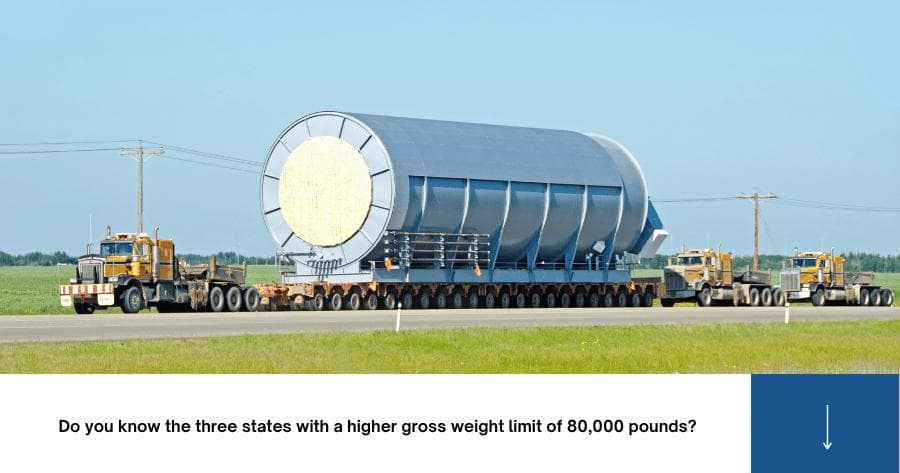
| Maximum weight for a legal CMV | • 48 states set maximum gross vehicle weight at 80,000 pounds, which is the federally mandated standard. • 3 states set higher gross vehicle weight limits. Those states are Maine at 100,000 lbs. Washington at 105,500 lbs. and Wyoming at 117,000 lbs. |
Commercial Motor Vehicles (CMVs) that surpass the standard weight limit of 80,000 lbs. will require additional considerations and precautions. These heavier CMVs, often referred to as Overweight/Over-dimensional (OS/OW) vehicles, require special permits, route planning, and sometimes even modifications to infrastructure to ensure their safe and legal operation.
- Special Permits: Heavier CMVs must acquire special permits for their operation. These permits are typically state-specific and may vary in terms of the maximum allowable weight. They may also specify certain operational conditions such as allowed travel time and necessary vehicle escorts.
- Route Planning: Given their size and weight, these CMVs may be restricted from certain roads or bridges. Therefore, comprehensive route planning is critical to identify a safe and legal path for these vehicles.
- Infrastructure Modifications: In some cases, the infrastructure may need to be altered or reinforced to accommodate these heavier vehicles. This could include strengthening existing bridges, widening roads, or creating temporary structures.
- CMVs may require additional axles: The addition of these axles helps to spread the load over a larger area, reducing the weight exerted on any single point of the infrastructure. This helps to prevent damage to roads and bridges, and ensures the vehicle can operate safely and efficiently.
Managing CMVs heavier than 80,000 lbs. involves a multi-faceted approach that requires appropriate permits, careful route planning, and possible infrastructure modifications. These measures ensure that these vehicles can operate safely without damaging the road infrastructure or posing a risk to other road users.
Liability of Overloaded Vehicles
Overloaded vehicles significantly increase legal exposure for carriers, supervisors, dispatchers, and drivers. When a crash involves overloaded vehicles, plaintiff attorneys often argue negligence, unsafe practices, or reckless disregard for public safety.
Even companies that operate under overweight permits must ensure their vehicles remain mechanically safe and properly configured. A permit does not eliminate liability if overloaded vehicles contribute to brake failure, tire blowouts, or loss of control.
The belief that weight restrictions do not apply universally is a dangerous misconception. Both supervisors and drivers might fall into the trap of thinking that they are somehow exempt from these regulations, but the truth is that no one is above prioritizing safety, regulations and compliance.
When overloaded vehicles are involved in serious crashes, litigation costs can reach hundreds of thousands or even millions of dollars. Jury verdicts continue trending higher, particularly when evidence suggests that weight violations were ignored.
Key liability risks include:
- Increased crash severity due to excess weight
- Higher probability of fatal outcomes
- Violation of vehicle maintenance regulations
- Exposure to nuclear verdicts
Preventing overloaded vehicles is not simply about avoiding fines. It is about protecting the company’s financial stability and reputation.
Safety Issues
Overloaded vehicles directly compromise vehicle dynamics. Excess weight shifts balance, reduces steering responsiveness, and increases rollover risk.
Steering and Stability
When overloaded vehicles carry excessive rear weight, front-axle steering traction decreases. This reduces directional control, particularly during lane changes or evasive maneuvers.
Braking Distance
Heavier vehicles require more stopping distance. Overloaded vehicles place extreme strain on braking systems, increasing heat buildup and the risk of brake fade or failure.
Tire Stress
Tires on overloaded vehicles operate under elevated heat and pressure. This significantly raises the likelihood of blowouts.
Component Fatigue
Suspension systems, tie rods, driveline components, and axles endure forces beyond engineered limits when operating overloaded vehicles.
Reducing overloaded vehicles improves stability, decreases crash risk, and protects drivers and the motoring public.
Maintenance Issues
The financial impact of overloaded vehicles often appears gradually through increased repair frequency and shortened equipment life cycles.
Repair Costs
Overloaded vehicles accelerate brake wear, strain engines, and degrade suspension systems. These repairs are predictable and preventable.
Downtime
When overloaded vehicles break down, revenue stops. Missed deliveries damage customer relationships and increase operational stress.
Tire Replacement
Tire failures are significantly more common when fleets routinely operate overloaded vehicles. Blowouts also create roadside hazards and potential secondary crashes.
Maintaining proper load limits extends asset life and reduces preventable maintenance expenses.
Regulation Violations
Operating overloaded vehicles violates federal and state weight regulations. While 80,000 pounds remains the general federal interstate limit, enforcement intensity has increased through roadside inspections and weigh-in-motion systems.
Penalties vary by jurisdiction and severity of overload. In addition to fines, overloaded vehicles may be placed out of service until corrected.
Serious crashes involving overloaded vehicles can result in charges such as:
- Reckless endangerment
- Negligent homicide
- Criminal negligence
Carriers must ensure dispatch practices, loading procedures, and driver accountability systems prevent overloaded vehicles before they reach public roadways.
Signs of an Overloaded Truck
Recognizing the signs of overloaded vehicles can prevent catastrophic failure.
Common warning signs include:
- Rear suspension sagging
- Excessive tire bulging
- Difficulty steering
- Longer stopping distances
- Brake overheating odors
- Reduced acceleration on grades
Routine inspections and scale verification reduce the likelihood of operating overloaded vehicles unknowingly.
Why Overloading Your Truck is Bad
Overloading your truck is a common mistake that has serious consequences for both the driver and the vehicle. There are several reasons why overloading is bad, and understanding these reasons can help you avoid this dangerous practice.
- Vehicle Lifespan: The first and most obvious reason is that it shortens the lifespan of your vehicle. Trucks are designed to carry a specific weight. When that weight is exceeded, it puts undue stress on the vehicle’s components. This can lead to premature wear and tear and can significantly shorten the lifespan of your truck. If you want your vehicle to last, you must avoid overloading it.
- Suspension Failure: Overloading your truck can also lead to suspension failure. The rear suspension, in particular, is susceptible to this problem. If the truck is overloaded, the rear suspension may fail, causing the vehicle to become unstable. This can be dangerous, especially when driving at high speeds or in difficult weather conditions.
- Damage to Other Components: Overloading doesn’t just affect the suspension. It can also cause damage to other components of the vehicle. For example, the center bolts could crack under the pressure of an overloaded truck. This could lead to further problems with the suspension, making the truck even more unstable.
- Payload Damage: Another danger of overloading is the risk of damaging your payload. When a truck is overloaded, it’s more difficult to control. This can cause the truck to jostle around, potentially damaging the payload. If the payload is damaged, it could lead to financial loss, especially if the payload is valuable.
- Safety Risks: The dangers of overloading a truck aren’t just limited to the truck and its payload. Overloaded vehicles pose a significant risk to road safety. They are more difficult to control and can cause accidents. This is particularly true in poor weather conditions, where the extra weight can make the vehicle more difficult to handle.
Overloading your truck is a dangerous practice that should be avoided at all costs. It can lead to premature wear and tear on your vehicle, suspension failure, damage to other components, payload damage, and safety risks. So, next time you’re tempted to overload your truck, think about the potential consequences and make the safe choice.
How to Maximize Your Payloads without Going Over
Maximizing profitability does not require operating overloaded vehicles. Instead, fleets should focus on:
- Accurate load calculations
- Proper weight distribution
- Verified axle spacing
- Suspension upgrades where appropriate
- Clear dispatch communication
Understanding GVWR, GAWR, and bridge formula limits ensures fleets maximize revenue while eliminating overloaded vehicles.
What are GVWR, GAWR, and bridge formula limits?
1. GVWR – Gross Vehicle Weight Rating
GVWR stands for Gross Vehicle Weight Rating. It’s the manufacturer-specified maximum total weight of a vehicle including:
- the vehicle itself
- cargo
- fuel
- passengers
- accessories
Exceeding the GVWR means the vehicle is operating as an overloaded vehicle beyond what it was designed to carry safely.
Example: If a semi-tractor and trailer together weigh 30,000 lbs (empty), and the GVWR is 80,000 lbs, then 50,000 lbs is the maximum cargo and fluids combined the vehicle can legally carry without being overloaded.
You can learn more about GVWR.
2. GAWR – Gross Axle Weight Rating
GAWR stands for Gross Axle Weight Rating. This is a separate rating the manufacturer gives for each individual axle on the vehicle. It’s the maximum weight that specific axle is designed to support.
Why it matters for overloaded vehicles:
- If the total cargo fits under GVWR but is heavily concentrated on a particular axle, that axle can be overloaded even when total weight seems legal.
- That’s a common source of safety issues like tire failures, steering instability, or suspension damage.
3. Bridge Formula Limits
Even if a vehicle’s GVWR and GAWR are within their ratings, there’s a third set of limits that affects commercial trucks on many major roads and bridges, the Federal Bridge Gross Weight Formula.
What It Does
The Bridge Formula determines the maximum legal weight a truck can carry based on:
- the number of axles
- the spacing between those axles
This matters because bridges and road structures are more stressed by concentrated heavy loads than evenly distributed weight. Longer trucks with well-spaced axles can legally carry heavier total loads without becoming overloaded vehicles under Bridge Formula rules.
How It Works (Simplified)
The formula is traditionally expressed as:
Where:
- W = maximum allowable weight (lbs)
- L = distance (feet) between the first and last axles
- N = number of axles in the group
So even if the total is under GVWR (80,000 lbs), poor axle spacing can make the allowable legal weight lower.
Standard Federal Limits
The federal baseline limits under Bridge Formula and related regulations for most commercial trucks are:
- 80,000 lbs total gross weight
- 20,000 lbs on a single axle
- 34,000 lbs on a tandem axle group (two axles close together)
But actual allowed weight can be lower depending on axle spacing, that’s the Bridge Formula effect.
Training Makes a Difference
Training plays a critical role in reducing overloaded vehicles across fleets of all sizes.
Drivers must understand:
- How weight impacts braking
- How overloaded vehicles affect steering control
- How to identify early warning signs
- Legal consequences of weight violations
Fleet managers must reinforce:
- Load verification procedures
- Dispatch accountability
- Documentation standards
- Corrective training after violations
Companies that actively prevent overloaded vehicles reduce crash risk, protect CSA performance, and lower long-term operating costs.
Investing in structured training systems creates measurable reductions in overloaded vehicles and strengthens a company’s overall safety culture.

FAQs
What are the challenges of overloading vehicles?
Overloading vehicles can lead to increased fuel consumption, diminished vehicle stability, faster brake wear leading to potential brake failure, and a higher risk of tire blowouts.
How can a training management system help in preventing vehicle overloading?
Training management systems can educate drivers and fleet managers about the risks of overloading and provide practical skills on how to correctly load a vehicle, distribute weight evenly, and identify signs of overloading.
How can preventing overloading improve fuel consumption?
A correctly loaded vehicle uses fuel more efficiently than an overloaded one. This can translate into significant fuel cost savings over time.
Can avoiding vehicle overloading improve vehicle stability?
Yes, preventing overloading improves vehicle stability and maneuverability, thereby reducing the likelihood of accidents.
How does overloading impact the vehicle’s braking system?
Overloading increases pressure on the vehicle’s braking system, leading to faster brake wear and an increased risk of brake failure.
How does overloading affect tire performance?
Excessive weight strains tires, causing increased wear and a higher risk of blowouts. Properly loaded vehicles maintain optimal tire performance and longevity.
How can training help in the selection of vehicles?
Comprehensive training programs can improve decision-making in vehicle selection and scheduling, further lowering the chances of overloading.
Can training help in reducing maintenance and repair costs?
Yes, by avoiding overloading, you can reduce brake wear and tire strain, which can result in substantial savings on maintenance and repair expenses.
What are the risks associated with operating overloaded vehicles?
Operating overloaded vehicles can lead to serious mechanical issues and potential accidents. It can also result in increased wear and tear on the vehicle, causing more frequent breakdowns and higher maintenance costs.
Can training help in enhancing road safety?
Yes, by raising awareness among drivers, fleet managers, and the general public about the risks associated with overloaded vehicles, training can significantly enhance road safety.
How does overloading affect the lifespan of a vehicle?
Overloading puts undue stress on the vehicle’s components, leading to premature wear and tear and can significantly shorten the lifespan of a vehicle.
How does overloading a vehicle affect its payload?
When a truck is overloaded, it’s more difficult to control. This can cause the truck to jostle around, potentially damaging the payload.
What are some steps to prevent vehicle overloading?
Steps to prevent vehicle overloading include upgrading the rear springs, adding coil-over shock absorbers, and understanding the vehicle’s carrying capacity.
How does overloading affect the company’s profitability?
Overloading can lead to increased fuel consumption, frequent breakdowns, higher maintenance costs, and potential accidents. These factors can significantly affect a company’s profitability.
Can training help in improving customer commitment?
Yes, by reducing the likelihood of overloading and thereby reducing the frequency of breakdowns and delays in service or delivery, training can help improve customer commitment.
What are the financial implications of overloading a vehicle?
Overloading a vehicle directly correlates to an increase in the frequency of repairs due to the additional stress placed on the vehicle’s components. This can lead to higher wear and tear. The cost of these repairs can quickly add up, causing a significant financial blow to companies. Moreover, when a vehicle is undergoing repairs, it represents a loss of productivity and, consequently, a loss of potential revenue.


