
Immediate vs. Delayed Gratification Training
Which Training Style Wins?

Instant Results or Long-Term Gains?
Let’s be honest, we live in a world of instant results. Want dinner? Tap a few buttons and food shows up at your door. Curious about a random fact? Just ask your phone. From streaming to swiping, we’re trained to expect immediate satisfaction.
So, it’s no surprise that this same mindset creeps into our learning and development habits, whether we’re talking about workplace training, self-improvement, or even parenting. The real question is: Should we lean into this fast-paced, instant-results model in training, or should we double down on the long game with delayed gratification?
Let’s unpack both styles of training, their pros, cons, and how to strike a balance that actually gets results.
What Is Immediate Gratification Training?
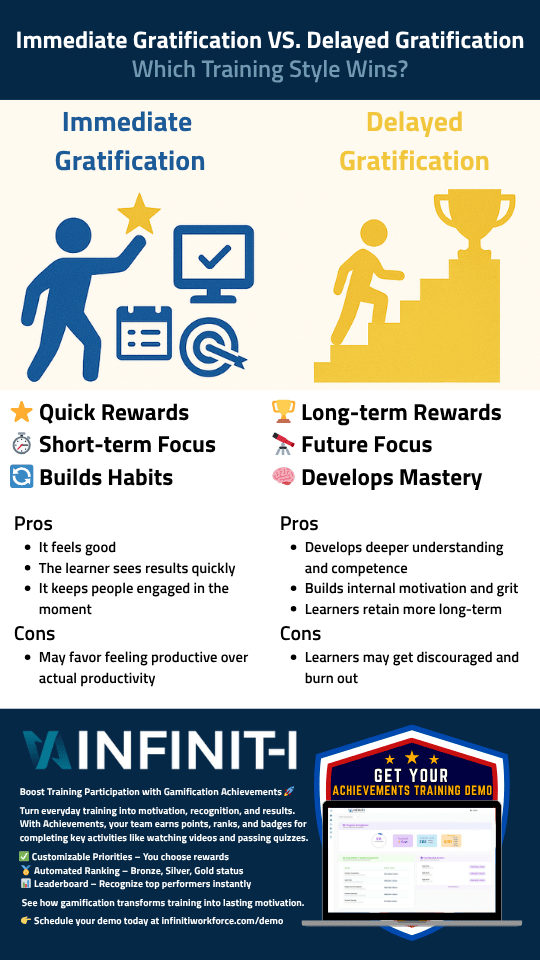
Immediate gratification training is exactly what it sounds like – learning that’s designed to give quick results and instant rewards. Think bite-sized videos, pop quizzes with instant feedback, gamification elements like badges, or a notification saying “You completed today’s lesson, great job!”
This model is heavily used in mobile learning apps, microlearning systems, and even fitness programs. It’s all about that dopamine hit, a little psychological “ping” that says: You did it. You’re awesome. Keep going.
Why it works:
- It feels good. The learner sees results quickly.
- It keeps people engaged in the moment.
- It’s easy to build habits around.
But there’s a catch.
Just like eating a candy bar gives you a sugar rush, and then leaves you crashing, immediate gratification training can sometimes focus more on feeling productive rather than actually being productive.
What Is Delayed Gratification Training?
Now let’s talk about the tortoise in this race.
Delayed gratification training is focused on long-term payoffs. There’s less emphasis on instant wins and more emphasis on building depth, mastery, and self-discipline. Think of it like training for a marathon, you don’t get a trophy on Day 1. You show up, consistently, and the results come later.
This kind of training often includes:
- In-depth coursework or certifications
- Hands-on practice or simulations
- Progress tracking over weeks or months
- Emphasis on building mental endurance
Why it works:
- It develops deeper understanding and real-world competence.
- It builds internal motivation and grit.
- It tends to stick – learners retain more long-term.
But again, there’s a trade-off.
Without small wins along the way, learners may burn out. It’s easy to get discouraged if results feel too far away, especially in a workplace where people are already juggling 1,000 things.

So, Which One Is Better?
Here’s the truth: It’s not a matter of either/or.
Immediate gratification and delayed gratification are tools, and just like a hammer or a screwdriver, the key is using them at the right time and in the right way.
Let’s look at a few real-world examples.
In the Workplace: Training Employees
Imagine onboarding a new employee. Do they want to read a 200-page manual on Day 1? No chance. But a short video that shows them how to clock in or submit their first report? That’s helpful – and rewarding.
This is where immediate gratification shines. Small, quick wins build confidence and momentum. The employee feels like they’re making progress, which encourages them to keep going.
But over time, you’ll need more than just quick wins.
Say your team member wants to grow into a management role. Now you’re talking about leadership courses, conflict resolution workshops, and months of development. Here’s where delayed gratification becomes essential.
If your training plan only feeds short-term hits without building the stamina for long-term goals, you’ll never develop true leaders, just task completers.
In Personal Development
Let’s bring it home.
If you’re trying to get better at public speaking, you might start with a YouTube video on how to control stage fright. It gives you an immediate strategy. Boom – you feel better already.
But if you really want to own the room, you’ll need to put in time: join Toastmasters, speak in front of groups, get feedback, and keep refining. The confidence and skill? They come later.
The same goes for learning a language, getting in shape, or building financial literacy. Immediate rewards help you start. Delayed gratification helps you grow.
The Psychology Behind Both
Psychologists have studied this contrast for decades – you’ve probably heard of the “marshmallow test.” In this famous experiment, kids were given a choice: eat one marshmallow now or wait and get two later.
The kids who were able to wait generally went on to have better outcomes in life, higher SAT scores, better emotional regulation, even more successful careers.
Why? Because delayed gratification is strongly tied to self-control, patience, and the ability to work for bigger goals.
But here’s the kicker: those kids weren’t born more disciplined. Many learned it. And one of the best ways to teach it? Through strategic use of immediate rewards.
In other words, you can build a habit of delayed gratification, and using immediate feedback and short-term goals along the way can help you get there.
The Best Training Uses Both
If you’re developing a training program, whether for your company, your clients, or yourself, the real magic happens when you blend both styles.
Here’s how:
- Start with Immediate Wins
Hook people with fast results. Use quizzes, badges, or simple progress bars to show completion. Let people see they’re moving forward.
Example: “Complete your first lesson and earn a badge” or “You’ve unlocked the next level!”
- Layer in Long-Term Value
Once learners are engaged, shift toward deeper goals. Introduce modules that build progressively and require reflection, application, or hands-on skills.
Example: “Submit your own case study” or “Demonstrate skill mastery over 30 days.”
- Show the Roadmap
Let learners know upfront that while some wins are quick, others take time. Set clear expectations about both short- and long-term rewards.
Example: “This 4-week course will get you certified, but here’s what you’ll accomplish each week.”
- Use Data to Encourage Progress
Track growth over time. People love to see how far they’ve come, and this can turn long-term training into something visually and emotionally rewarding.
Example: “You’ve improved 35% in your skills since starting this course!”
Train the Brain, Then the Behavior
Here’s something to think about: Every training program isn’t just teaching skills, it’s shaping behavior. And behavior is tied to how we feel about progress.
If learners only feel successful when they “win,” they’ll chase short-term gains. But if they’re coached to enjoy the process, to value progress over perfection, you’ll end up with learners who are resilient, thoughtful, and engaged for the long haul.
So if you’re designing a training strategy – or just thinking about how you learn, ask yourself:
- Where can I build momentum quickly?
- Where do I need to plant seeds that grow slowly?
- And how can I enjoy both the sprint and the marathon?
Because the truth is: You don’t have to choose between fast or slow. You just have to choose to keep moving forward.

Take the Next Step in Safer Training
Boost Training Participation with Gamification Training we are calling Achievements 🚀
Turn everyday training into motivation, recognition, and results. With Achievements, your team earns points, ranks, and badges for completing key activities like watching videos and passing quizzes.
✅ Customizable Priorities – You choose rewards
🏅 Automated Ranking – Bronze, Silver, Gold status
📊 Leaderboard – Recognize top performers instantly
See how gamification transforms training into lasting motivation.
👉 Complete the form now to get started with INFINITI
FAQs
What is Delayed Gratification Training?
Delayed Gratification Training is a learning method that focuses on long-term results instead of immediate rewards. Unlike instant gratification, which gives quick feedback and recognition, delayed gratification emphasizes persistence, self-control, and the ability to work toward bigger outcomes. Learners are encouraged to practice skills consistently, build depth, and accept that the benefits will show later. Delayed Gratification Training is widely used in education, corporate programs, and personal development because it helps create lasting knowledge, resilience, and stronger performance over time.
Why is Delayed Gratification Training important in the workplace?
In the workplace, Delayed Gratification Training helps employees develop patience, persistence, and real mastery of their jobs. While short-term wins are motivating, long-term performance relies on deeper understanding and continuous effort. For example, leadership development or compliance mastery cannot be achieved overnight. Delayed Gratification Training builds the discipline employees need to stay committed even when immediate rewards are not present. This leads to stronger retention, higher productivity, and long-term success, especially in roles that require responsibility, problem-solving, and independent decision-making.
How does Delayed Gratification Training differ from Immediate Gratification Training?
Immediate gratification focuses on quick results, such as earning badges, receiving instant feedback, or celebrating small milestones. Delayed Gratification Training, on the other hand, emphasizes working over a longer period before receiving rewards. For example, in immediate gratification, a learner might complete a short quiz and instantly see results. In delayed gratification, the learner might spend weeks studying, practicing, and applying knowledge before receiving recognition or certification. Both methods have value, but Delayed Gratification Training builds endurance, resilience, and mastery that lasts.
What are the benefits of Delayed Gratification Training?
The benefits of Delayed Gratification Training include improved long-term retention, deeper understanding, and stronger self-discipline. Learners who experience delayed gratification develop the patience to handle complex tasks that cannot be solved quickly. This training builds mental endurance, which is essential for leadership, problem-solving, and career growth. It also improves intrinsic motivation, since learners learn to value progress itself instead of just chasing rewards. By focusing on meaningful long-term goals, Delayed Gratification Training produces more capable, confident, and adaptable individuals.
What are the challenges of Delayed Gratification Training?
One of the main challenges of Delayed Gratification Training is keeping learners motivated when rewards feel far away. Without small wins, some may lose interest or feel discouraged. In busy workplaces, long training cycles can seem overwhelming. Another challenge is balancing delayed rewards with the need for regular feedback. If not managed properly, learners might disengage before reaching the benefits. Successful programs often combine Delayed Gratification Training with occasional short-term reinforcement to maintain engagement while still prioritizing long-term growth.
How does psychology support Delayed Gratification Training?
Psychology strongly supports Delayed Gratification Training through studies such as the famous “marshmallow test.” Children who could wait for a bigger reward instead of taking a smaller one immediately tended to achieve better life outcomes. This shows the power of patience, self-regulation, and long-term thinking. Delayed Gratification Training builds those same skills in adults by teaching them to focus on larger rewards over time. It trains the brain to value persistence and helps learners develop habits that lead to lasting success.
Can Delayed Gratification Training improve leadership skills?
Yes, Delayed Gratification Training is especially effective for leadership development. True leadership is not built through quick wins but through continuous learning, problem-solving, and long-term relationship-building. By practicing delayed gratification, leaders learn patience, resilience, and the ability to make decisions that benefit their teams in the future. Leadership courses, mentoring programs, and long-term development plans all rely on delayed gratification. When leaders understand the value of waiting for meaningful results, they inspire others and create sustainable growth.
How can Delayed Gratification Training help in personal development?
Delayed Gratification Training plays a powerful role in personal growth. Whether it is learning a new language, developing fitness habits, or improving financial literacy, results rarely appear overnight. By embracing delayed gratification, individuals commit to consistent practice and long-term goals. This mindset helps them resist distractions, avoid shortcuts, and stay focused. For example, saving money for retirement requires years of discipline, and fitness goals require months of training. Delayed Gratification Training ensures progress sticks and builds real confidence.
How do you keep learners motivated in Delayed Gratification Training?
To keep learners motivated during Delayed Gratification Training, programs should include clear goals, progress tracking, and regular feedback. Even though rewards are delayed, small checkpoints can reassure learners they are moving forward. Tools like progress charts, peer support, or milestone recognition can make the journey less discouraging. Combining short-term reinforcement with long-term outcomes helps learners stay engaged. Motivation increases when learners see how their efforts today connect to meaningful future results, which is the heart of Delayed Gratification Training.
What are examples of Delayed Gratification Training in real life?
Examples of Delayed Gratification Training include studying for a degree, preparing for professional certifications, or training for a marathon. Each requires months or years of consistent effort before results are visible. In the workplace, developing leadership skills, mastering a new technology, or completing an advanced training program all reflect delayed gratification. Even personal goals like learning an instrument or building savings accounts are forms of Delayed Gratification Training. The process teaches discipline and patience while producing long-term rewards.
Is Delayed Gratification Training suitable for children?
Yes, Delayed Gratification Training is valuable for children but must be age-appropriate. Young learners benefit from practicing patience and understanding that waiting often brings better rewards. For example, saving allowance money for a bigger toy instead of buying something small immediately teaches delayed gratification. In education, longer projects or gradual skill development encourage persistence. By introducing Delayed Gratification Training early, children build habits that prepare them for future challenges, such as academic success, career development, and personal growth.
How does Delayed Gratification Training build resilience?
Delayed Gratification Training builds resilience by teaching learners to stay focused even when progress feels slow. Instead of giving up when results are not immediate, participants learn to push through challenges and trust the process. This resilience applies to all areas of life, from education to careers. For example, employees who practice delayed gratification are more likely to complete long projects without losing motivation. By strengthening patience and determination, Delayed Gratification Training creates individuals who thrive under pressure and uncertainty.
How do you measure success in Delayed Gratification Training?
Measuring success in Delayed Gratification Training requires looking beyond short-term results. Instead of just tracking quiz scores or completion rates, organizations measure long-term outcomes such as retention, mastery, and application of skills on the job. Learners who succeed in delayed gratification show steady progress, consistent effort, and improved real-world performance. Surveys, long-term assessments, and post-training evaluations provide insights into effectiveness. The ultimate measure is whether learners apply their training successfully over time, proving that delayed gratification creates lasting impact.
Can Delayed Gratification Training reduce burnout?
Yes, Delayed Gratification Training can reduce burnout by shifting focus from chasing constant quick wins to building sustainable progress. When learners understand that growth takes time, they are less likely to feel pressure for instant results. Instead, they value steady improvement and meaningful achievements. Programs that use delayed gratification emphasize balance and patience, which helps reduce frustration. By building endurance, learners can pace themselves and avoid the exhaustion that often comes from constantly chasing immediate rewards.
Why should companies include Delayed Gratification Training in employee programs?
Companies should include Delayed Gratification Training because it creates employees who are motivated, disciplined, and capable of long-term growth. In fast-paced industries, short-term training may boost initial engagement, but it often fails to create real competence. Delayed gratification ensures employees develop skills that endure, such as leadership, technical mastery, and problem-solving. It also builds loyalty, since employees who experience meaningful development feel invested in the organization. By prioritizing Delayed Gratification Training, companies build a stronger, more resilient workforce.


